Last Updated: September 2026
If you’re buying a home, renewing your policy, or simply wondering whether you’re paying too much, one question comes up quickly: How much does homeowners insurance cost in 2026?
The short answer is that there isn’t one price for everyone.
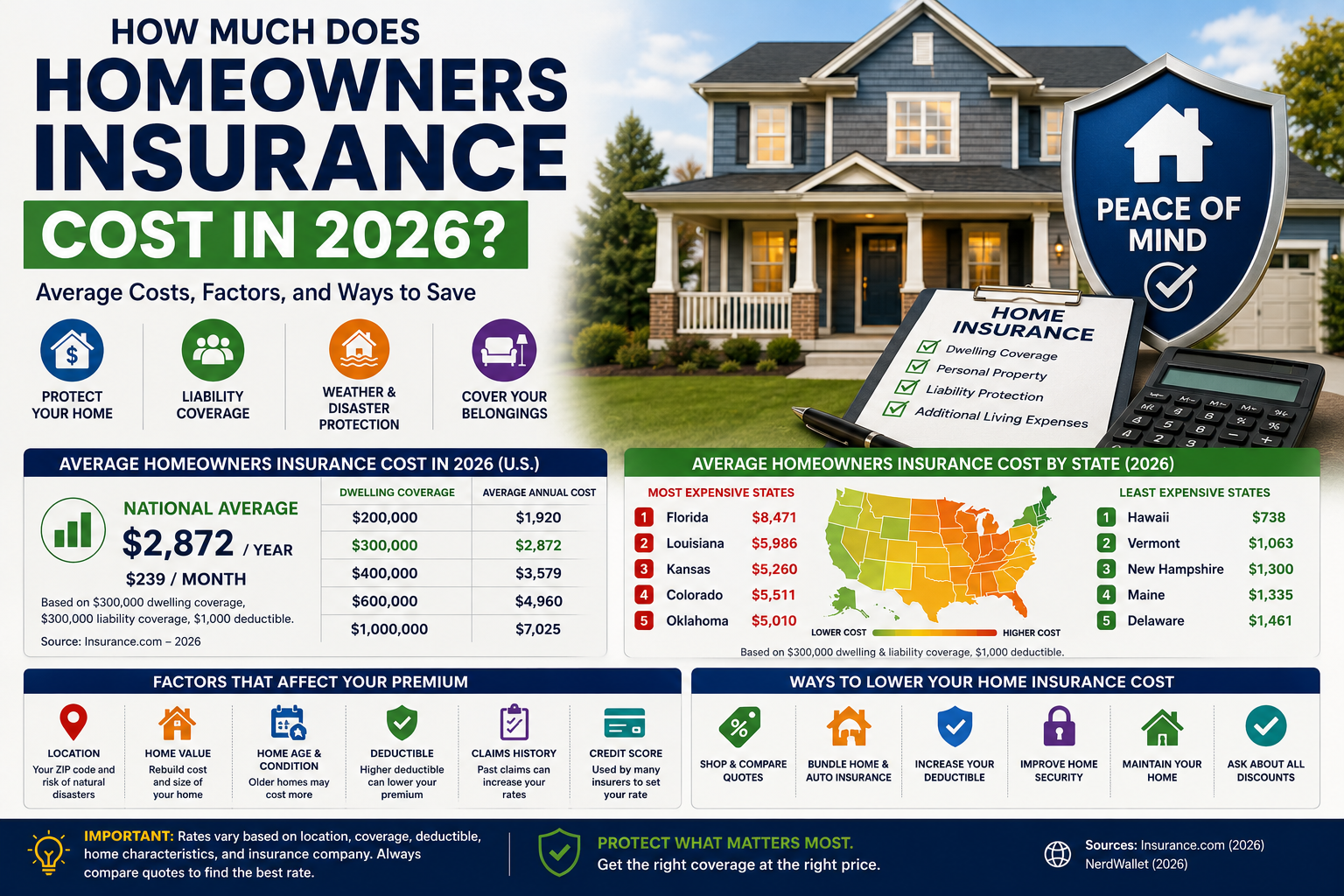
Current 2026 data shows that the average U.S. homeowner may pay roughly $2,500 to $2,900 per year for a standard policy, depending on the coverage amount and methodology used. For example, Insurance.com reports an average of $2,872 per year ($239 per month) for $300,000 of dwelling coverage, $300,000 of liability coverage and a $1,000 deductible. NerdWallet’s 2026 analysis reports $2,490 per year ($208 per month) for $400,000 of dwelling coverage with a $1,000 deductible.
That difference is important: homeowners insurance rates depend heavily on the home, location, coverage limits, deductible and insurance company.
Average Homeowners Insurance Cost in 2026
For a useful national benchmark, Insurance.com’s 2026 data puts the average cost at:
| Coverage | Average Cost |
|---|---|
| $200,000 dwelling coverage | About $1,920/year |
| $300,000 dwelling coverage | About $2,872/year |
| $400,000 dwelling coverage | About $3,579/year |
| $600,000 dwelling coverage | About $4,960/year |
| $1 million dwelling coverage | About $7,025/year |
These figures are based on a $1,000 deductible and $300,000 in liability coverage, with a 2% hurricane deductible where applicable.
In other words, a homeowner with a $300,000 dwelling limit might spend around $239 per month, while someone insuring a substantially more expensive home could pay considerably more.
Why Are Different Sources Reporting Different Averages?
You may see different numbers when searching for the average homeowners insurance cost.
That’s normal.
Insurance companies and research organizations use different sample homeowners, dwelling limits, deductibles, geographic mixes and calculation methods.
For example, NerdWallet’s 2026 analysis uses a $400,000 dwelling coverage benchmark and reports an average of $2,490 per year. Its analysis included rates from more than 100 insurance companies across all 50 states and Washington, D.C.
So instead of treating one national average as your expected premium, use these numbers as benchmarks.
Your actual quote could be much lower—or much higher.
Average Homeowners Insurance Cost by State
Where you live can have a major impact on your homeowners insurance premium.
Insurance.com reports that its 2026 state averages range from $738 per year in Hawaii to $8,471 per year in Florida for a policy with $300,000 in dwelling and liability coverage and a $1,000 deductible.
Some of the major state averages include:
| State | Average Annual Cost |
|---|---|
| Florida | $8,471 |
| Louisiana | $5,986 |
| Kansas | $5,260 |
| Colorado | $5,511 |
| Oklahoma | $5,010 |
| Nebraska | $4,553 |
| Kentucky | $4,042 |
| Missouri | $3,979 |
| Alabama | $3,716 |
| Texas | $4,085 |
| Hawaii | $738 |
| Vermont | $1,063 |
| New Hampshire | $1,300 |
| Maine | $1,335 |
| Delaware | $1,461 |
These are averages rather than guaranteed prices. Even homeowners in the same state can receive very different quotes.
For example, a coastal property exposed to hurricanes may cost substantially more to insure than a similar home located farther inland.
Why Is Homeowners Insurance So Expensive in Some States?
Insurance companies consider the likelihood and potential cost of future claims.
States with frequent hurricanes, tornadoes, wildfires, hailstorms, flooding risks or other severe weather can have significantly higher premiums.
Florida is a good example. Insurance.com’s 2026 data shows an average annual premium of $8,471 for its benchmark policy—far above the national average.
Several factors can contribute to higher rates:
- Hurricane and wind exposure
- Wildfire risk
- Tornado and hail frequency
- Higher construction costs
- Higher repair costs
- Insurance litigation
- Local claims history
- Limited availability of insurers
- Property location and proximity to high-risk areas
Insurance companies essentially price policies according to the amount of risk they expect to take on.
How Much Does Homeowners Insurance Cost Per Month?
If you prefer to budget monthly, here’s a simple way to look at the 2026 national benchmarks from Insurance.com:
| Dwelling Coverage | Approx. Monthly Premium |
|---|---|
| $200,000 | $180 |
| $300,000 | $239 |
| $400,000 | $298 |
| $600,000 | $413 |
| $1,000,000 | $585 |
These figures are based on Insurance.com’s 2026 methodology and should be treated as estimates rather than personalized quotes.
Remember that many homeowners don’t actually pay their insurer directly every month. Your mortgage lender may collect insurance money through an escrow account, meaning part of your monthly mortgage payment is set aside for your homeowners insurance and property taxes.
What Does Homeowners Insurance Cover?
A standard homeowners policy generally provides several types of protection.
The exact coverage depends on your policy, insurer and state, but common categories include:
Dwelling Coverage
This protects the structure of your home against covered losses.
It generally includes things such as the walls, roof and permanently attached structures.
Your dwelling coverage should be based on the estimated cost to rebuild the home—not simply its market value.
Other Structures
This can help cover certain detached structures on your property, such as:
- Detached garages
- Sheds
- Fences
- Certain other structures
Coverage limits depend on the policy.
Personal Property
This can help cover belongings inside your home after a covered loss.
Examples may include:
- Furniture
- Clothing
- Electronics
- Appliances
- Certain valuables
High-value items may have special coverage limits, so homeowners with expensive jewelry, collectibles or other valuables may need additional coverage.
Liability Coverage
Liability protection can help if you’re legally responsible for certain injuries or property damage involving other people.
For example, someone could potentially be injured on your property and make a claim against you.
Additional Living Expenses
If a covered loss makes your home temporarily unlivable, some policies may help pay certain additional living expenses while repairs are being completed.
Always check your policy for exclusions, limits and conditions.
What Factors Affect Your Homeowners Insurance Rate?
Insurance companies don’t simply look at the price of your house.
They consider multiple characteristics when calculating premiums.
1. Location
Your ZIP code can be one of the biggest factors.
Insurers may consider local weather risks, crime, fire protection, claims history and rebuilding costs.
Two homes with similar characteristics can have very different insurance premiums simply because they’re located in different areas.
2. Replacement Cost
The amount it could cost to rebuild your home matters.
A larger or more expensive-to-rebuild house generally requires more dwelling coverage.
Insurance.com’s 2026 data shows average premiums increasing as dwelling coverage rises.
3. Age of the Home
Older homes can sometimes cost more to insure because certain systems may be outdated.
Insurers may pay particular attention to:
- Roof condition
- Electrical systems
- Plumbing
- Heating systems
- Foundation
- Overall construction
4. Roof Condition
Your roof protects the entire house, so its age and condition can affect your premium and eligibility.
A newer, impact-resistant or otherwise qualifying roof may potentially reduce risk and could qualify for a discount with some insurers.
5. Deductible
Your deductible is the amount you generally pay out of pocket before insurance pays for a covered claim.
For example, with a $2,500 deductible, you would generally be responsible for the first $2,500 of a covered loss before the insurer contributes, subject to the policy terms.
A higher deductible can reduce premiums, but you need to be comfortable paying that amount if you have a claim.
6. Claims History
Your previous insurance claims can influence how an insurer evaluates your risk.
A history of multiple claims may result in higher premiums or fewer available options depending on the insurer and state.
7. Credit-Based Insurance Information
In many states, insurers may use credit-based insurance information when determining homeowners insurance rates.
However, rules vary by state.
NerdWallet identifies credit history, along with location, home size and age, as important factors that can affect homeowners insurance costs.
8. Home Features
Certain features can increase insurance costs or change how an insurer evaluates the property.
Examples include:
- Swimming pools
- Hot tubs
- Detached structures
- High-value possessions
- Older electrical systems
- Certain heating systems
How Much Homeowners Insurance Do You Need?
The cheapest policy isn’t necessarily the best policy.
Your goal should be to have enough coverage to protect the financial value of what you could lose.
A common mistake is choosing dwelling coverage based solely on the home’s purchase price.
The amount needed to rebuild can differ from the home’s market value because land value, local construction costs, materials and labor all affect the calculation.
You should also consider:
- Personal property coverage
- Liability limits
- Additional living expenses
- Replacement-cost options
- Valuable personal property
- Additional structures
If you’re unsure how much coverage you need, an insurance professional can help estimate appropriate limits.
How to Lower Your Homeowners Insurance Cost
If your renewal premium has increased, don’t assume your only option is to pay it.
There are several ways you may be able to reduce your premium.
Compare Multiple Insurance Companies
This is one of the most important steps.
Different insurers can price the same home very differently.
Insurance.com’s 2026 research also shows meaningful differences between major insurers, reinforcing why comparing quotes can matter.
Try to compare similar coverage limits, deductibles and endorsements so you’re comparing policies fairly.
Ask About Discounts
Depending on the insurer, discounts may be available for things such as:
- Bundling home and auto insurance
- Security systems
- Smoke alarms
- Certain home improvements
- New roofs
- Claims-free history
- Automatic payments
Discount availability varies by company and state.
Consider a Higher Deductible
If you can comfortably afford a larger deductible, ask your insurer how much your premium would change.
Don’t choose a deductible so high that a normal emergency would create financial stress.
Improve Home Security
Security systems and qualifying protective devices may reduce risk.
Ask your insurer whether your particular equipment qualifies for a discount before purchasing it solely for insurance savings.
Upgrade Older Systems
Replacing outdated roofing, plumbing or electrical components may improve the property’s risk profile.
However, major home improvements should be made because they make sense for the property—not solely because you expect an insurance discount.
Review Your Coverage Every Year
Your insurance needs can change.
You may have:
- Renovated your home
- Purchased expensive electronics
- Sold valuable items
- Added a pool
- Built an addition
- Changed your deductible
- Added security equipment
Reviewing your policy at renewal can help make sure your coverage still matches your situation.
Why Are Home Insurance Rates Rising in 2026?
Homeowners across the U.S. have faced higher insurance costs in recent years.
One reason is the increasing cost of repairing and rebuilding homes.
Construction materials, labor and other expenses affect how much insurers may have to pay after covered losses.
Severe weather is another major factor.
Wildfires, hurricanes, hailstorms and tornadoes can generate large numbers of expensive claims.
Insurance.com notes that insurers are also dealing with challenges in high-risk markets where some companies have reduced their exposure or stopped writing certain policies.
NerdWallet similarly reports that insurance premiums have risen amid inflation and natural-disaster losses.
Frequently Asked Questions
Is $200 a month expensive for homeowners insurance?
Not necessarily.
$200 per month equals $2,400 per year, which is close to the national benchmarks reported by several 2026 analyses.
However, whether that is expensive depends on your home’s location, coverage amount, deductible and risk profile.
What is the average homeowners insurance cost in 2026?
There is no single universal average.
Insurance.com reports about $2,872 per year for a $300,000 dwelling and liability coverage benchmark, while NerdWallet reports about $2,490 per year for $400,000 of dwelling coverage. Different methodologies explain much of the difference.
Which state has the most expensive homeowners insurance?
According to Insurance.com’s 2026 state analysis, Florida has the highest average rate at approximately $8,471 per year for its $300,000 dwelling coverage benchmark.
Which state has the cheapest homeowners insurance?
Insurance.com’s 2026 data lists Hawaii as the lowest-cost state in its benchmark, at about $738 per year.
Can I lower my homeowners insurance premium?
Potentially, yes.
Comparing insurers, asking about discounts, reviewing coverage, considering a higher deductible and improving certain home features may reduce your premium depending on your circumstances.
Does a higher deductible lower homeowners insurance?
Generally, choosing a higher deductible can reduce the premium because you’re accepting more out-of-pocket responsibility when you make a covered claim.
But the savings vary by insurer, so ask for quotes with multiple deductible options.
Final Takeaway
So, how much does homeowners insurance cost in 2026?
A reasonable national benchmark is roughly $2,500–$2,900 per year, but that number can be misleading if you use it as a personal quote.
Your actual homeowners insurance cost depends on factors such as your state, ZIP code, home’s replacement cost, age, roof, deductible, claims history, coverage limits and insurance company.
For a $300,000 dwelling coverage benchmark, Insurance.com reports an average of about $2,872 per year, or roughly $239 per month, while NerdWallet’s $400,000 benchmark comes in at about $2,490 per year, or $208 per month.
The smartest approach is to compare several insurers using the same coverage limits and deductible. That gives you a much better idea of whether you’re getting a competitive price than relying on a national average alone.
Important: Insurance rates change frequently, and actual premiums can differ substantially from published averages. Always compare personalized quotes and review the policy’s coverage, exclusions, deductibles and limits before purchasing.
SEO Package
SEO Title: How Much Does Homeowners Insurance Cost in 2026? Average Rates
Meta Description: How much does homeowners insurance cost in 2026? See average home insurance rates, costs by state, factors that affect premiums and ways to save money.
Suggested URL:zuni2i.fun/how-much-does-homeowners-insurance-cost-2026/
Primary Keyword:how much does homeowners insurance cost in 2026
Secondary Keywords:
- average homeowners insurance cost 2026
- average home insurance cost
- homeowners insurance rates 2026
- average home insurance premium
- home insurance cost by state
- how much is homeowners insurance
- homeowners insurance monthly cost
- cheapest homeowners insurance states
- home insurance rates by state
Featured Image Text:
HOW MUCH DOES HOMEOWNERS INSURANCE COST IN 2026?
Suggested Internal Links:
- How Much Should Car Insurance Cost in 2026?
- Best Car Insurance Companies in 2026
- How to Lower Your Car Insurance Premium
- Car Insurance Rates by State: 2026 Guide
- Best Homeowners Insurance Companies in 2026
- Best Insurance Companies in 2026: Compare Your Options