Last Updated: September 2026
Choosing the best car insurance company isn’t simply about finding the lowest monthly premium. A good policy should give you the coverage you need at a competitive price while also providing reliable claims service, useful discounts, and a customer experience you can count on when something goes wrong.
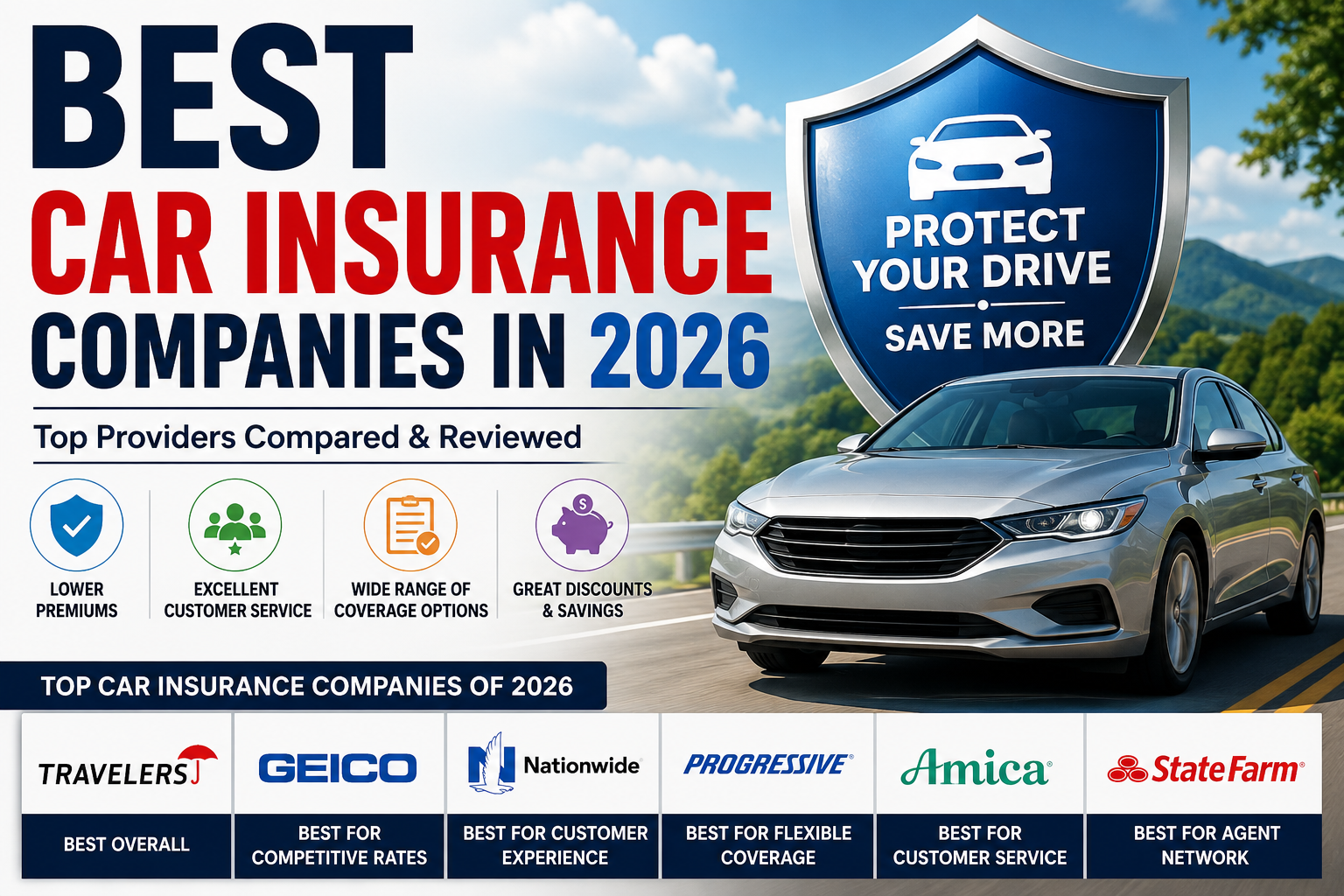
In 2026, Travelers, GEICO, Nationwide, Progressive, and Amica stand out among the companies receiving strong ratings from major insurance-industry and consumer-data sources. However, the best option for you can depend heavily on your state, driving record, vehicle, age, coverage needs, and eligibility.
Insurance.com currently ranks Travelers No. 1 overall, followed by GEICO and Nationwide, based on a combination of rates, customer experience, complaints, and financial-strength factors.
Best Car Insurance Companies in 2026
Here are some of the leading options worth comparing:
| Company | Best For | Overall 2026 Rating* |
|---|---|---|
| Travelers | Best overall | 4.55/5 |
| GEICO | Competitive rates | 4.50/5 |
| Nationwide | Customer satisfaction | 4.19/5 |
| Progressive | High-risk & flexible options | 4.05/5 |
| Amica | Customer service | 4.02/5 |
| State Farm | Large agent network | 3.91/5 |
*Ratings shown above are from Insurance.com’s 2026 comparison and are not insurance quotes or guarantees.
The right choice can still vary by driver and location.
1. Travelers — Best Overall Car Insurance Company
Travelers takes the top spot in Insurance.com’s 2026 ranking, with a 4.55/5 overall rating. The ranking considers factors including rates, customer satisfaction, complaints and financial strength.
Why Travelers stands out
Travelers offers a broad selection of standard and optional auto insurance coverage, making it suitable for many different types of drivers.
Potential advantages include:
- Competitive pricing for many driver profiles
- Multiple coverage options
- Various discounts
- Accident forgiveness options
- Strong financial strength
- Availability across much of the U.S.
Travelers also ranked first nationally among the companies included in Insurance.com’s 2026 comparison.
Who should consider Travelers?
Travelers is worth getting a quote from if you want a large national insurer with a combination of competitive rates and extensive coverage options.
However, don’t assume it will automatically be the cheapest option for you. Insurance pricing is personalized.
2. GEICO — Best for Competitive Rates
GEICO ranks second in Insurance.com’s 2026 overall comparison, with a rating of 4.50/5.
The company is widely known for competitive pricing and a large selection of discounts.
Why GEICO stands out
Depending on your profile, GEICO may offer discounts related to factors such as:
- Safe driving
- Multiple vehicles
- Vehicle safety equipment
- Military service
- Federal employment
- Driver education
- Defensive driving
The actual discounts available depend on your location and eligibility.
Who should consider GEICO?
GEICO is worth comparing if your priority is finding a competitive premium while maintaining standard auto insurance coverage.
It can be particularly useful to obtain a quote alongside other major insurers rather than assuming one company will always be cheapest.
3. Nationwide — Best for Customer Experience
Nationwide ranks third in Insurance.com’s 2026 comparison, with an overall rating of 4.19/5 and a customer satisfaction rating of 4.41/5.
Why Nationwide stands out
Nationwide provides several coverage and policy-management options, along with discounts that can potentially reduce premiums.
The company also participates in usage-based insurance programs, which may allow eligible drivers to have their driving behavior considered when determining pricing.
Who should consider Nationwide?
Nationwide may be worth considering if you want a large insurer with a broad range of coverage options and a strong customer-experience score.
4. Progressive — Best for Flexible Coverage Options
Progressive is another major national insurer that deserves a place on your comparison list.
Insurance.com’s 2026 ranking places Progressive fourth among its top national insurers, with an overall rating of 4.05/5.
Why Progressive stands out
Progressive offers a wide range of insurance products and several ways for drivers to potentially lower premiums.
The company is also known for its usage-based Snapshot program, which uses driving information to determine potential discounts for eligible customers.
Progressive can be particularly worth considering if you want to compare traditional pricing with usage-based insurance.
Who should consider Progressive?
Progressive may be a good company to quote if you’re looking for flexible policy options or want to compare rates using a usage-based program.
5. Amica — Best for Customer Service
Amica ranks fifth in Insurance.com’s 2026 national comparison, with an overall rating of 4.02/5 and a customer satisfaction score of 4.19/5.
Customer service can be especially important with insurance because the quality of your experience may matter most when you actually need to file a claim.
J.D. Power’s 2026 auto insurance study also shows that customer experience varies considerably by region, reinforcing the importance of looking beyond price alone.
Who should consider Amica?
Drivers who place a high value on service and want to compare a customer-focused insurer against larger national brands may want to request a quote from Amica.
6. State Farm — Best for a Large Local Agent Network
State Farm is one of the largest names in U.S. auto insurance and remains an important company to include when comparing quotes.
Insurance.com’s 2026 comparison gives State Farm an overall rating of 3.91/5 and a customer satisfaction rating of 4.38/5.
One potential advantage is its extensive agent network.
For drivers who prefer dealing with a local agent instead of managing everything digitally, this can be an important consideration.
Which Car Insurance Company Is Cheapest in 2026?
There is no single insurer that is cheapest for every driver.
Your premium can change based on:
- Age
- State
- ZIP code
- Driving history
- Credit-based insurance information where permitted
- Vehicle make and model
- Annual mileage
- Coverage limits
- Deductible
- Claims history
- Previous insurance history
Two people driving the same car can receive completely different quotes.
That’s why comparing multiple insurers is usually more useful than relying on a national “cheapest company” list.
Which Car Insurance Company Is Best for Good Drivers?
Drivers with clean records should compare several major insurers rather than choosing based on brand reputation alone.
Travelers, GEICO, Nationwide, Progressive, Amica and State Farm are all reasonable companies to include in a quote comparison.
Some insurers also offer safe-driving or telematics programs that can potentially provide discounts to eligible drivers.
Your final rate will depend on your individual profile.
Best Car Insurance for Young Drivers
Young drivers often face higher premiums because they generally have less driving experience.
Parents and younger drivers can look for insurers that offer:
- Good-student discounts
- Defensive-driving discounts
- Driver-training discounts
- Safe-driving programs
- Multi-car discounts
- Bundling opportunities
Adding a young driver to a family policy may also be worth comparing with purchasing a separate policy.
Don’t assume one option is automatically cheaper—get quotes for both scenarios.
Best Car Insurance for Seniors
Older drivers should compare insurers based on both price and available discounts.
Potential savings may be available through:
- Mature-driver discounts
- Defensive-driving courses
- Low-mileage programs
- Bundling
- Safe-driving programs
GEICO, Travelers, Nationwide, State Farm and other large insurers can all be included when shopping around.
The cheapest company for one senior driver may be considerably more expensive for another.
Best Car Insurance After an Accident
An at-fault accident can increase your insurance premium, but the size of the increase varies by insurer and driver.
If you’ve recently had an accident, compare quotes from multiple companies before renewing.
Some insurers offer accident-forgiveness programs for qualifying drivers.
It’s also important to ask whether accident forgiveness is automatically included or requires eligibility based on your driving history and policy tenure.
Best Car Insurance for High-Risk Drivers
Drivers with speeding tickets, multiple accidents or other violations may have fewer affordable options.
Progressive and other large insurers may be worth including in your comparison, but pricing varies significantly by individual profile.
High-risk drivers should compare several quotes rather than assuming a company is expensive or inexpensive based on national averages.
What Makes a Car Insurance Company “Best”?
Price is important, but it shouldn’t be the only factor.
When comparing insurers, consider these five areas:
1. Price
Your premium should fit your budget, but make sure you’re comparing equivalent policies.
A cheaper policy with lower coverage limits isn’t necessarily a better deal.
2. Coverage
Check whether the insurer offers the protection you actually need.
Common coverage types include:
- Liability
- Collision
- Comprehensive
- Uninsured motorist
- Underinsured motorist
- Personal injury protection
- Medical payments
- Rental reimbursement
Not every coverage is required in every state.
3. Claims Experience
The real test of an insurer often comes after an accident.
J.D. Power’s latest available U.S. Auto Claims Satisfaction Study ranked Erie Insurance highest at 743/1,000, followed by NJM Insurance at 731 and Liberty Mutual at 730.
This is a useful reminder that the company offering the cheapest quote isn’t necessarily the company with the highest claims satisfaction.
4. Financial Strength
An insurer’s financial strength can be another useful factor because you want a company capable of meeting its obligations.
Independent ratings agencies such as AM Best provide financial-strength ratings that consumers can consider alongside price and service.
5. Customer Service
Digital tools are convenient, but good customer service can become especially important when you’re dealing with a claim.
J.D. Power’s 2026 study found that only 58% of customers said they completely understood their auto policy, highlighting how important clear communication can be.
How to Compare Car Insurance Companies
Getting multiple quotes is one of the best ways to find competitive pricing.
Step 1: Gather your information
Have the following available:
- Driver’s license information
- Vehicle identification number
- Current mileage
- Address
- Driving history
- Current insurance details
- Desired coverage limits
Step 2: Choose your coverage limits
Don’t compare companies using completely different policies.
For a useful comparison, keep your:
- Liability limits
- Deductibles
- Collision coverage
- Comprehensive coverage
- Optional coverage
as similar as possible.
Step 3: Get multiple quotes
Compare at least three insurers when possible.
A quote from one company doesn’t tell you what another company will charge.
Step 4: Check discounts
Ask each insurer which discounts you’re eligible for.
Step 5: Compare more than the premium
Look at:
- Coverage
- Deductibles
- Claims reputation
- Customer service
- Financial strength
- Digital tools
- Cancellation terms
Then choose the policy that provides the best overall value.
Why the Best Insurer Can Change by State
One of the biggest mistakes consumers make is assuming a national ranking applies equally everywhere.
J.D. Power’s 2026 U.S. Auto Insurance Study ranked different insurers highest across its regional markets.
For example:
- California: Wawanesa
- Central: Shelter Insurance
- Florida: Florida Farm Bureau Insurance
- Mid-Atlantic: Erie Insurance
- New England: Amica
- New York: Travelers
- North Central: Erie Insurance
- Northwest: State Farm
- Southeast: Erie Insurance
- Southwest: CSAA Insurance Group
- Texas: Automobile Club of Southern CA (AAA)
This shows why a national list should be treated as a starting point rather than a guarantee of the best company for every driver.
Frequently Asked Questions
What is the best car insurance company in 2026?
There isn’t one company that is best for everyone. Insurance.com currently ranks Travelers first overall among the companies in its 2026 comparison, followed by GEICO and Nationwide.
What is the cheapest car insurance company in 2026?
The cheapest insurer depends on your driver profile, location, vehicle and coverage. Compare several companies rather than relying on a single national ranking.
Is GEICO cheaper than Progressive?
It can be for some drivers, but not for everyone. Insurance companies use different pricing models, so you should compare personalized quotes.
Is Travelers good car insurance?
Travelers is highly rated in several 2026 comparisons and currently ranks first in Insurance.com’s overall ranking.
Is State Farm good car insurance?
State Farm remains a major national insurer and has strong regional customer-satisfaction performance in J.D. Power’s 2026 study.
How many car insurance companies should I compare?
Three to five quotes can give you a much better idea of whether your current premium is competitive. Make sure you’re comparing similar coverage levels.
Should I choose the cheapest insurance?
Not necessarily.
A policy should provide adequate coverage for your situation. Saving money on your premium isn’t helpful if you significantly reduce protection that you may need after a serious accident.
Final Verdict: Which Car Insurance Company Is Best in 2026?
For a general starting point, Travelers currently stands out as one of the strongest overall choices based on Insurance.com’s 2026 ranking. GEICO is worth considering for competitive pricing, Nationwide for customer experience, Progressive for flexible options, and Amica for customer service.
But there is no universal winner.
Your best car insurance company is the one that gives you the right combination of coverage, price, claims service and customer support.
Before purchasing or renewing a policy, compare multiple personalized quotes using the same coverage limits and deductibles.
That extra comparison could save you money without forcing you to sacrifice important coverage.