Last Updated: September 2026
If you’re shopping for life insurance in 2026, one of the first questions you’ll probably ask is:
How much does life insurance cost?
The answer depends on several factors, including your age, health, smoking status, coverage amount, policy type and term length.
For a useful 2026 benchmark, NerdWallet reports that a healthy nonsmoking 40-year-old can pay about $321 per year for a $500,000, 20-year term life insurance policy if male, or $278 per year if female. That’s approximately $27 and $23 per month, respectively.
But life insurance rates can change dramatically with age and health.
A 60-year-old buying the same $500,000, 20-year term policy could pay thousands of dollars per year, while a younger applicant may pay only a few hundred dollars.
That’s why understanding how insurers calculate premiums can help you make a smarter decision.

Average Life Insurance Cost in 2026
NerdWallet’s latest 2026 analysis puts the overall average cost of life insurance at around $26 per month, but this number represents a broad benchmark rather than a personalized quote.
For term life insurance, a $500,000, 20-year policy for a healthy nonsmoker can cost approximately:
| Age | Men — Annual | Women — Annual | Men — Monthly | Women — Monthly |
|---|---|---|---|---|
| 20 | $210 | $175 | $18 | $15 |
| 30 | $213 | $182 | $18 | $15 |
| 40 | $321 | $278 | $27 | $23 |
| 50 | $810 | $636 | $68 | $53 |
| 60 | $2,331 | $1,640 | $194 | $137 |
| 70 | $9,702 | $7,953 | $809 | $663 |
These figures are based on a $500,000, 20-year term life policy for preferred applicants in good health, using the lowest three rates for each age averaged together. The data was valid as of August 1, 2026, and actual quotes can differ.
The table demonstrates one of the most important facts about life insurance:
Buying coverage earlier can be significantly less expensive.
How Much Does Term Life Insurance Cost?
Term life insurance is generally the most straightforward type of life insurance.
You purchase coverage for a specific period, such as:
- 10 years
- 15 years
- 20 years
- 25 years
- 30 years
If you die while the policy is active, the beneficiaries generally receive the death benefit, subject to the policy terms.
For healthy nonsmokers, NerdWallet’s 2026 rate analysis shows the following approximate annual costs for a $500,000 policy:
10-Year Term
- 40-year-old man: $201/year
- 40-year-old woman: $175/year
20-Year Term
- 40-year-old man: $321/year
- 40-year-old woman: $278/year
30-Year Term
- 40-year-old man: $574/year
- 40-year-old woman: $451/year
Longer coverage periods generally cost more because the insurer is taking on risk for more years.
How Much Does Whole Life Insurance Cost?
Whole life insurance is generally more expensive than term life insurance because it is designed to provide lifelong coverage and includes a cash-value component.
For a healthy nonsmoker purchasing a $500,000 whole life policy, NerdWallet’s 2026 data shows these approximate annual rates:
| Age | Men — Annual | Women — Annual |
|---|---|---|
| 20 | $1,539 | $1,345 |
| 30 | $2,207 | $1,929 |
| 40 | $3,180 | $2,849 |
| 50 | $4,983 | $4,317 |
| 60 | $8,335 | $7,304 |
| 70 | $15,273 | $13,812 |
For a 40-year-old healthy nonsmoking applicant, that works out to roughly $265 per month for a man and $237 per month for a woman.
Compare that with approximately $27 and $23 per month for the corresponding 20-year term policies.
This illustrates why comparing term and permanent insurance based solely on the death benefit can be misleading.
The policies are designed for different purposes.
Term Life vs. Whole Life: Cost Comparison
Here’s a simplified comparison using 2026 sample rates for a healthy 40-year-old nonsmoker:
| Policy | Male Annual Cost | Female Annual Cost |
|---|---|---|
| $500K, 10-year term | $201 | $175 |
| $500K, 20-year term | $321 | $278 |
| $500K, 30-year term | $574 | $451 |
| $500K whole life | $3,180 | $2,849 |
The difference is substantial.
A 20-year term policy in this example costs hundreds of dollars per year, while the comparable whole life policy costs several thousand dollars per year.
That doesn’t mean whole life is automatically a bad choice.
Permanent insurance can serve different financial purposes, but its higher premium means you should understand why you’re buying it and what features you’re receiving.
How Much Does Life Insurance Cost for a 30-Year-Old?
Age 30 is still relatively inexpensive in the 2026 sample rates.
For a healthy nonsmoker purchasing $500,000 of 20-year term coverage:
- Male: approximately $213/year
- Female: approximately $182/year
That’s about:
- Male: $18/month
- Female: $15/month
Of course, these are sample averages rather than guaranteed prices.
Your health, insurer, coverage amount and underwriting classification can change the quote.
How Much Does Life Insurance Cost for a 40-Year-Old?
For a healthy nonsmoker buying $500,000 of 20-year term coverage in the 2026 sample:
Male: approximately $321/year
Female: approximately $278/year
That’s approximately:
$27/month for men
$23/month for women
At this age, buying a longer 30-year term increases the sample annual cost to approximately $574 for men and $451 for women.
How Much Does Life Insurance Cost for a 50-Year-Old?
Rates become noticeably higher by age 50.
For a healthy nonsmoker with a $500,000, 20-year term policy:
- Male: approximately $810/year
- Female: approximately $636/year
That’s roughly:
- $68/month for men
- $53/month for women
This is one reason many people choose to purchase life insurance while they are younger rather than waiting until they have a greater need.
How Much Does Life Insurance Cost for a 60-Year-Old?
At age 60, the difference becomes much more dramatic.
For the same $500,000, 20-year term policy for a healthy nonsmoker:
- Male: approximately $2,331/year
- Female: approximately $1,640/year
That’s approximately:
- $194/month for men
- $137/month for women
The exact price can vary considerably depending on underwriting and insurer.
How Much Does Life Insurance Cost for Smokers?
Smoking can have a major impact on life insurance premiums.
NerdWallet’s 2026 sample rates show that a 40-year-old male smoker could pay approximately $1,455 per year for a $500,000, 20-year term policy, compared with about $321 for a healthy nonsmoker.
For a 40-year-old female smoker, the corresponding sample is approximately $1,157 per year, compared with $278 for a healthy nonsmoker.
Here’s a broader comparison:
| Age | Male Nonsmoker | Male Smoker | Female Nonsmoker | Female Smoker |
|---|---|---|---|---|
| 30 | $213 | $795 | $182 | $645 |
| 40 | $321 | $1,455 | $278 | $1,157 |
| 50 | $810 | $3,495 | $636 | $2,560 |
| 60 | $2,331 | $8,435 | $1,640 | $6,001 |
These figures are sample averages from 2026 and demonstrate how strongly smoking status can affect premiums.
Why Is Life Insurance More Expensive for Smokers?
Insurers price policies based partly on expected mortality risk.
Smoking is associated with higher risks of several serious health conditions, so insurers generally charge smokers more.
Other tobacco and nicotine use can also affect underwriting depending on the insurer and product.
It’s important to answer application questions accurately.
Providing incorrect information about smoking or other health factors can create problems if the insurer later reviews the application or claim.
What Factors Affect Life Insurance Cost?
Age and smoking status are important, but they’re not the only factors.
Here are some of the biggest variables insurers may consider.
1. Age
Generally, life insurance becomes more expensive as you get older.
The 2026 rate tables demonstrate this clearly.
A healthy 30-year-old may pay only a few hundred dollars per year for substantial term coverage, while a healthy 60-year-old can pay several thousand dollars.
2. Health
Your current health can significantly affect your premium.
Insurers may consider information such as:
- Height and weight
- Blood pressure
- Cholesterol
- Medical history
- Prescription history
- Family medical history
- Existing health conditions
NerdWallet notes that health information is one of the major factors used in determining life insurance rates.
3. Smoking
Smokers generally pay significantly more.
As the 2026 rate data shows, the difference can be several times the nonsmoker rate.
4. Coverage Amount
A $1 million policy will generally cost more than a $500,000 policy because the insurer is providing a larger death benefit.
However, the price doesn’t necessarily double exactly when coverage doubles.
5. Policy Length
A 30-year term generally costs more than a 20-year term because the insurer provides coverage for an additional decade.
6. Policy Type
Term insurance generally has lower premiums than permanent insurance.
Whole life and other permanent policies can include cash value and lifelong coverage, which contribute to their higher cost.
7. Risk Class
Applicants may be placed into different underwriting categories.
For example:
- Preferred Plus
- Preferred
- Standard
- Higher-risk categories
A healthier applicant may qualify for lower premiums.
NerdWallet’s 2026 data shows meaningful differences between preferred-plus, preferred and standard rates.
8. Occupation and Hobbies
Certain high-risk occupations and hobbies can affect premiums.
Examples may include:
- Aviation
- Commercial diving
- Certain hazardous occupations
- Skydiving
- Other high-risk activities
NerdWallet notes that risky jobs and hobbies can affect life insurance rates.
How Much Does a $1 Million Life Insurance Policy Cost?
The answer depends heavily on age, health and policy length.
You shouldn’t assume that a $1 million policy simply costs twice as much as a $500,000 policy.
Insurers use their own pricing models.
For example, a healthy 30-year-old buying a 20-year term policy may receive a very different quote from a healthy 50-year-old purchasing the same $1 million benefit.
The best way to determine the actual cost is to compare personalized quotes from multiple insurers.
How Much Does No-Exam Life Insurance Cost?
You can sometimes purchase life insurance without taking a traditional medical exam.
However, skipping the exam doesn’t necessarily mean the policy will be cheaper.
For a $500,000, 20-year no-exam term policy, NerdWallet’s 2026 data shows these sample annual rates for nonsmokers:
| Applicant | Preferred Plus | Preferred | Standard |
|---|---|---|---|
| Woman, 30 | $184 | $215 | $330 |
| Woman, 40 | $280 | $340 | $495 |
| Woman, 50 | $640 | $756 | $1,135 |
| Man, 30 | $214 | $274 | $399 |
| Man, 40 | $330 | $410 | $639 |
| Man, 50 | $815 | $974 | $1,499 |
No-exam insurance can be convenient, but it’s important to compare the coverage, underwriting method, exclusions and price with traditional policies.
Is Life Insurance Cheaper If You Buy It Young?
Generally, age is a major factor in life insurance pricing.
The 2026 data shows that a healthy 30-year-old can pay substantially less than a healthy 50-year-old for the same $500,000, 20-year term policy.
There is another reason to consider buying earlier.
Your health can change.
If you develop a serious health condition later, getting a new policy may become more expensive or more difficult.
That doesn’t mean everyone should buy a large policy as young as possible.
Your coverage needs should still match your financial responsibilities.
How to Get Cheaper Life Insurance
You can’t control every factor affecting your premium, but there are several things you can do.
Compare Multiple Insurers
Don’t assume every company will give you the same price.
Life insurance underwriting varies between insurers.
Comparing multiple quotes can help you identify a better rate for your particular profile.
Buy Only the Coverage You Need
More coverage means higher premiums.
Calculate your actual financial needs before choosing a policy.
If you need $750,000, there’s little reason to automatically buy $2 million simply because you qualify for it.
Choose the Right Term
Don’t automatically choose a 30-year policy if your financial responsibilities may disappear sooner.
For example, if your children will become financially independent and your mortgage will be paid off within 20 years, a 20-year term might fit your needs better.
Improve Your Health
Depending on the insurer, improving certain health factors before applying may help you qualify for a better risk class.
Potentially relevant factors include:
- Maintaining a healthy weight
- Managing blood pressure
- Managing cholesterol
- Avoiding tobacco
- Following healthy lifestyle habits
Don’t delay necessary coverage solely to chase a lower rate, however.
Stop Smoking
Smoking can have a dramatic impact on premiums.
If you’ve quit, ask insurers how they classify former smokers and how long you need to be tobacco-free to qualify for nonsmoker rates.
Rules vary.
Avoid Buying More Riders Than You Need
Life insurance riders can add useful benefits, but some may increase the premium.
Review each rider carefully and determine whether it provides meaningful value for your situation.
Term Life Insurance vs. Whole Life: Which Is Cheaper?
If your only question is which generally costs less, term life insurance usually wins.
A healthy 40-year-old in NerdWallet’s 2026 sample pays approximately:
$321/year for a $500,000, 20-year term policy as a man.
Compared with:
$3,180/year for a $500,000 whole life policy.
For women, the corresponding figures are approximately $278 and $2,849.
But cost isn’t the only difference.
Term insurance provides coverage for a defined period, while permanent policies are designed for longer-term coverage and may include cash value.
The right choice depends on your financial goals.
How Much Should You Spend on Life Insurance?
There’s no universal percentage of income that everyone should spend.
Instead, work backward from your coverage need.
First determine:
How much coverage do I need?
Then determine:
How long do I need it?
Then compare:
How much will different insurers charge for that coverage?
This approach is better than starting with a budget and buying whatever coverage fits into it.
Can Life Insurance Premiums Increase?
It depends on the policy.
Many level-term policies are designed to keep premiums level during the guaranteed period.
Other policies may have different premium structures.
Permanent insurance can also have more complicated pricing depending on the type of policy.
Before purchasing, check whether your premium is:
- Guaranteed
- Level
- Renewable
- Adjustable
- Subject to change
Read the policy documents carefully rather than assuming all life insurance works the same way.
What Happens If You Outlive Your Term Life Insurance?
If you survive the term, the policy generally ends without paying a death benefit.
For example, if you buy a 20-year policy at age 35 and remain alive at age 55, the original term has ended.
Depending on the policy, you may have options such as:
- Renewing the policy
- Converting to permanent insurance
- Purchasing a new policy
The exact options depend on your contract and insurer.
NerdWallet notes that many term policies include conversion provisions, but the rules vary by policy.
Should You Buy Life Insurance Through Your Employer?
Employer-sponsored life insurance can be valuable, but it may not provide enough coverage for your family’s needs.
Some workplace plans provide coverage based on your salary.
For example, if your employer provides one year’s salary and you earn $100,000, you may receive $100,000 of employer-provided coverage.
That could be far less than the amount needed to replace your income, pay off debts and support your family.
Another issue is job changes.
Your employer coverage may not remain with you if you leave the company, depending on the plan.
For that reason, many people consider having an individual policy in addition to employer coverage.
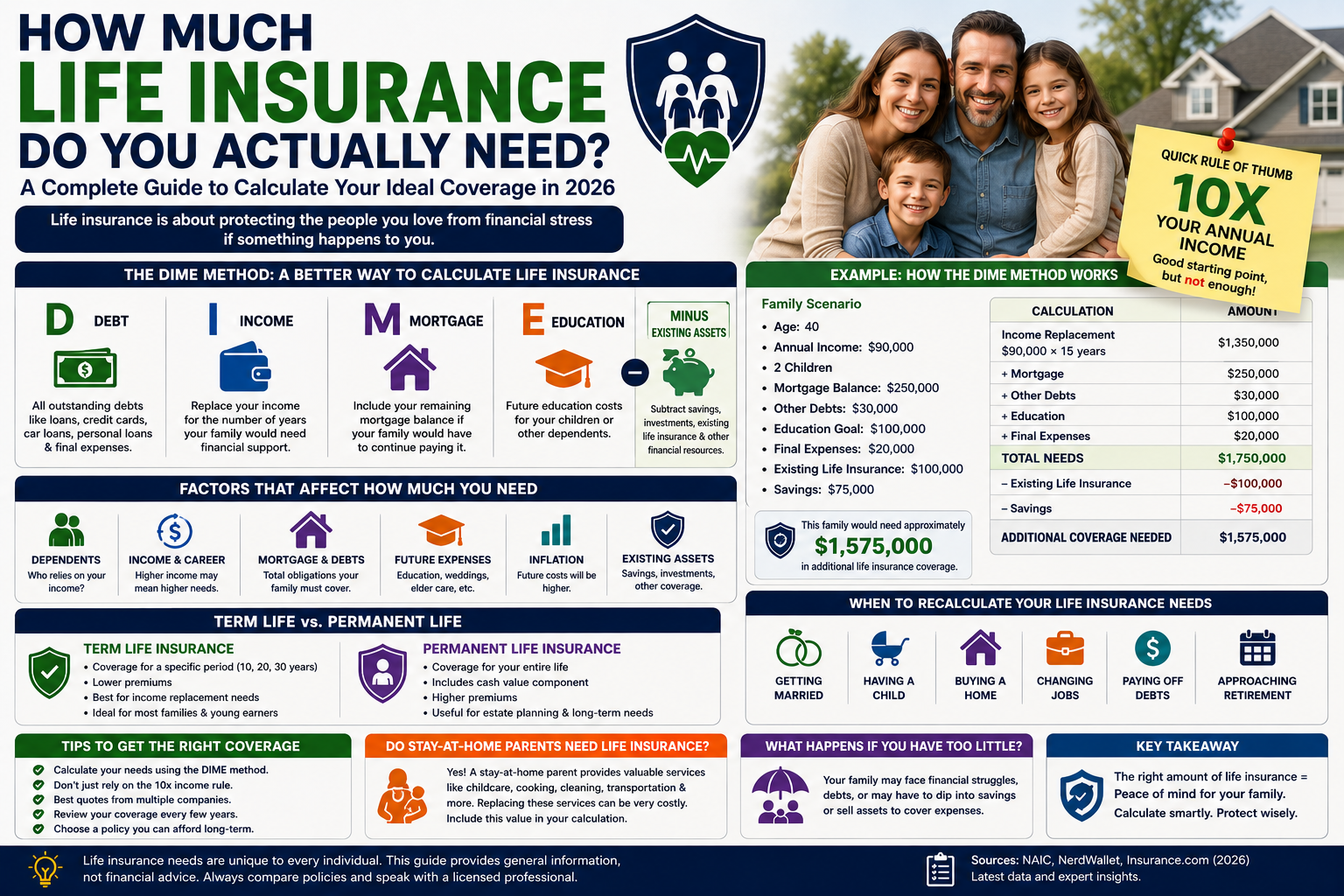
How Much Life Insurance Do You Need?
Cost should come after coverage needs.
A simple starting formula is:
Income Replacement + Mortgage + Debts + Education + Final Expenses − Existing Assets and Insurance
For a more detailed explanation, see our guide:
How Much Life Insurance Do You Actually Need?
The amount you need depends on who relies on your income and what financial obligations your family would face.
Frequently Asked Questions
What is the average cost of life insurance in 2026?
NerdWallet reports an overall average of about $26 per month, although actual costs vary substantially by age, health, policy type and coverage amount.
How much is a $500,000 life insurance policy?
For a healthy nonsmoker, a $500,000, 20-year term policy can cost roughly a few hundred dollars per year when you’re younger.
For example, NerdWallet’s 2026 sample shows $213/year for a 30-year-old male and $182/year for a 30-year-old female.
How much does life insurance cost at age 40?
For a healthy nonsmoker buying $500,000 of 20-year term coverage, the 2026 sample rate is approximately $321/year for men and $278/year for women.
Is life insurance expensive?
It depends on the policy.
Term life insurance can be relatively inexpensive for healthy younger applicants, while permanent insurance can cost substantially more.
Is term life insurance cheaper than whole life?
Generally, yes.
Term insurance typically has lower premiums because it provides coverage for a defined period rather than lifelong coverage.
Does smoking make life insurance more expensive?
Yes.
The 2026 sample rates show substantially higher premiums for smokers compared with nonsmokers.
Does health affect life insurance rates?
Yes.
Insurers may consider your health, medical history, height and weight, blood pressure, cholesterol and other factors when determining your risk class.
Is no-exam life insurance cheaper?
Not necessarily.
No-exam policies can be convenient, but the price depends on the insurer, underwriting method, applicant and coverage.
Is it better to buy life insurance when you’re young?
Buying earlier can generally mean lower premiums because age is a major pricing factor.
However, you should still buy coverage based on your actual financial needs.
Final Takeaway
So, how much does life insurance cost in 2026?
For a healthy nonsmoker, a $500,000, 20-year term life insurance policy can cost only a few hundred dollars per year when you’re young.
For example, current 2026 sample rates show:
- Age 30 male: $213/year
- Age 30 female: $182/year
- Age 40 male: $321/year
- Age 40 female: $278/year
- Age 50 male: $810/year
- Age 50 female: $636/year
- Age 60 male: $2,331/year
- Age 60 female: $1,640/year
But life insurance isn’t priced based on age alone.
Your health, smoking status, coverage amount, policy term, risk class, occupation, hobbies and insurer can all influence your premium.
If you’re shopping for coverage, don’t focus solely on finding the lowest monthly payment. First determine how much coverage your family actually needs, then compare multiple insurers offering similar policies.
A cheap policy with insufficient coverage may not accomplish the purpose of buying life insurance in the first place.
Important: The rates in this article are published 2026 sample averages and are not guaranteed quotes. Actual premiums vary by applicant, insurer, state, underwriting class, policy type and coverage. Life insurance is a financial product; review policy terms carefully and consider professional advice when appropriate.
SEO Package
SEO Title: How Much Does Life Insurance Cost in 2026? Average Rates
Meta Description: How much does life insurance cost in 2026? See average term and whole life insurance rates by age, smoking status, coverage amount and policy length.
Suggested URL:zuni2i.fun/how-much-does-life-insurance-cost-2026/
Primary Keyword:how much does life insurance cost in 2026
Secondary Keywords:
- average life insurance cost 2026
- life insurance rates 2026
- average life insurance rates
- how much is life insurance
- life insurance cost by age
- term life insurance cost
- whole life insurance cost
- $500,000 life insurance cost
- life insurance cost for 40 year old
- life insurance cost for smokers
- cheapest life insurance 2026
- no exam life insurance cost
Featured Image Text:
HOW MUCH DOES LIFE INSURANCE COST IN 2026?
Suggested Internal Links:
- How Much Life Insurance Do You Actually Need?
- Best Homeowners Insurance Companies in 2026
- How Much Does Homeowners Insurance Cost in 2026?
- Best Car Insurance Companies in 2026
- How Much Should Car Insurance Cost in 2026?
- How to Lower Your Car Insurance Premium
- How Much Does Health Insurance Cost in 2026?
- Best Insurance Companies in 2026: Compare Your Options